PTS MONTHLY INDUSTRY SPOTLIGHT - August 2026

Written by
Andrew MacWilliams
Published on
26 Aug 2026
PTS MONTHLY INDUSTRY SPOTLIGHT
5th EDITION – August 2026
FROM THE EDITOR
Business Development Is Becoming a Team Sport
Andrew MacWilliams | CHIEF GROWTH OFFICER
"Business development is a team sport."
A client and I both blurted this out on a call recently. We laughed, but that old proverb is truer in 2026 than it's ever been.
Think about basketball. The triangle offense gave way to motion offenses, which ultimately evolved into today’s pace-and-space game. The objective never changed: score more points than the other team. But positions have become more fluid, players are expected to do more, and success depends less on individual specialists and more on how well the team functions together.
Federal business development is going through something similar. In fact, I'd argue business development organizations have changed more in the last two years than they did in the previous twenty.
The reason is simple: the government is buying differently.
For decades, the federal acquisition system excelled at buying things it could clearly define. Write a requirement. Establish evaluation criteria. Solicit bids. Evaluate them. Make an award. That model still works when the government knows exactly what it wants.
Increasingly, however, agencies know they have a mission problem before they know exactly what the solution should be. Sometimes, they can’t even articulate the problem.
Artificial intelligence, autonomous systems, cybersecurity, advanced analytics, and other emerging technologies progress at a rate that laps the government’s full understanding. To keep pace, agencies are increasingly turning to acquisition pathways that allow them to engage industry earlier, experiment faster, and refine solutions before formal requirements exist.
Programs like SBIR, AFWERX, Army xTech, NavalX, SpaceWERX, the Defense Innovation Unit, and other innovation initiatives have dramatically expanded the ways commercial technology companies can engage government customers. Rather than waiting for a fully developed RFP, companies now have opportunities to demonstrate capabilities, prototype solutions, and help shape how agencies think about solving mission problems. And that matters enormously for business development.
Notice something missing from that process?
Capture. That’s intentional.
Traditional capture is largely built around influencing and competing to provide defined products and services the government already intends to buy. The emerging model looks very different, because it requires companies to engage while the government is still deciding what it should buy in the first place.
Traditional Growth Model
- Identify the opportunity
- Capture the opportunity
- Write the proposal
- Win the award
Emerging Growth Model
- Discover the problem
- Develop the solution
- Build the prototype
- Demonstrate the capability
- Iterate with the customer
- Transition into production
The best capture managers in the world can shape requirements. But increasingly, the most valuable engagement happens before there are requirements to shape. The new era of federal business development starts long before pen ever hits paper.
While “consulting” may occasionally feel like a four-letter word in today’s federal environment, much of today’s cutting-edge technology is being sold through what looks remarkably like a consultative sales model. How does that differ from traditional capture? Capture is trench warfare. Consultative selling is hand-to-hand combat. Get close to the customer. Understand the mission. Understand the problem. Understand what’s already been tried, and why it didn’t work. Then solution. Then prototype. Then demonstrate. Then iterate. If it works, then move toward production.
That also changes the economics of growth.
Organizations are investing earlier. Engineers, solution architects, product teams, and business developers are collaborating long before significant revenue exists. Companies are funding prototypes, demonstrations, and integrations before traditional opportunities even emerge. The traditional GovCon model often asked, "How much will it cost to capture this opportunity?" The emerging technology model increasingly asks, "How much are we willing to invest to create the opportunity?"
Which brings us back to basketball.
Yesterday's growth organizations had clearly defined positions. Business developers found opportunities. Capture managers won them. Solution architects designed them. Proposal teams wrote them. Operations delivered them. Everyone had a position.
Today's best growth organizations look much more positionless. Business developers need enough technical fluency to identify solvable customer problems. Engineers need enough customer awareness to participate in discovery. Solution architects have to think commercially. Operations engages before contract award. Leadership must be willing to invest before opportunities fully materialize.
None of this means Shipley is dead. Large, competitive procurements will still be won the traditional way, nobody is taking down a billion-dollar recompete by showing up with a whiteboard and a demo.
But the companies that learn to do both won’t just have better business developers. They’ll have better business development teams. The old playbook still works. It’s just no longer the only playbook. A new era of federal business development is here. And the teams built to win yesterday may not be the teams built to win tomorrow.
Past Performance Highlights
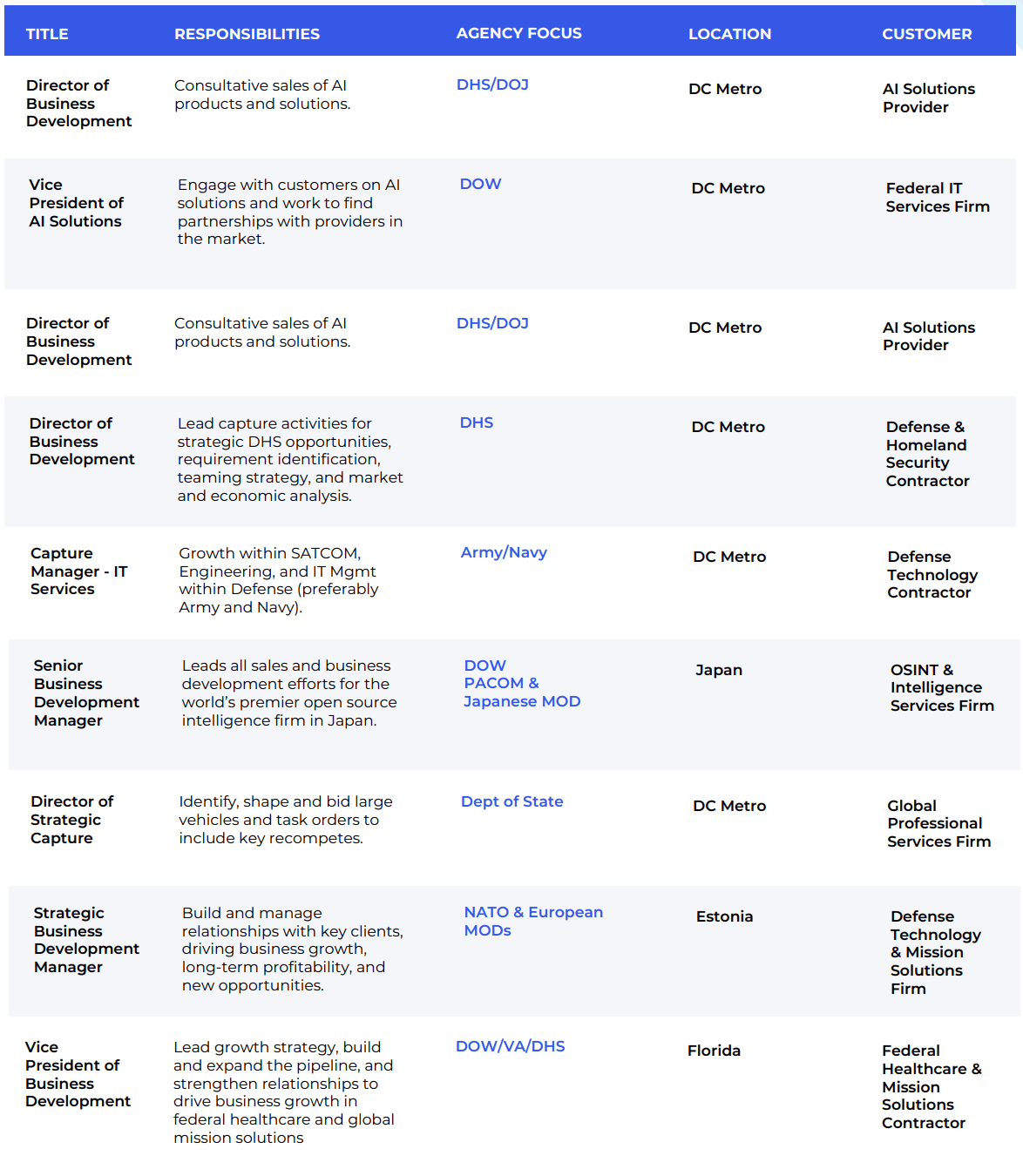
In this industry, business development executives turn over like college basketball coaches. It doesn’t have to be that way. PTS understands the qualities and cultural attributes needed for success in business development in GovCon. Here are just a few of our recent placements.
THE FUTURE OF GOVCON
Client and Industry Perspectives
We are grateful to share perspectives from industry leaders who have appeared as guests on The Future of GovCon podcast.
Tim Garnett
Partner & Practice Lead, Aerospace & Defense, Oliver Wyman
- The face-to-market shift is the biggest change BD teams haven't made yet. The old model was work the back channels, shape the requirement, and be in pole position when the RFP drops. This administration operates differently. The door is open — but only if you walk in with a solution, not a question.
- Bring the solution or don't come. The government does not want more cost-plus time-and-materials bodies. They want capabilities. What does it do? How will you deliver it? What value does it create? That commercial mentality is the sea change most legacy BD organizations are still struggling to make.
- The companies winning right now are leaning forward. They know what the problem is before requirements exist and are bringing an 80 percent solution into a room and letting the customer say go. That is a fundamentally different motion than traditional capture.
- This is a generational leadership change moment. The skills that made someone a great BD leader over the last 25 years are not necessarily the skills required for the next five. Organizations that figure out how to be more dynamic in how they go to market and who they put in front of customers are the ones that will take share.
- One word: Dynamic. The acquisition environment, the competitive landscape, the technology — all of it is more dynamic than it has ever been. Leaders who cannot operate in that environment will be replaced by ones who can.
Byron Bright
Former President, Government Services, KBR
- Nobody handed Byron a BD career. He came out of the Air Force, landed in GovCon after Katrina, and took his first BD job with an honest admission: he had never read an RFP. That starting point is actually the point — the best growth leaders in this industry are often not the ones who came up through the traditional capture track.
- Relationships and networks are the only currency that compounds. Every major pivot in Byron's career happened through a relationship, not an application. In a market where BD cycles are compressing and access is everything, the depth of your network is your most durable competitive advantage.
- M&A is a BD strategy, not just a finance exercise. At KBR, the acquisitions Byron led were about buying access to markets, people, and knowledge the company did not have. When they acquired a company with better customer knowledge, they put that company's leadership in charge. Every deal taught them something they took into the next one.
- The market is splitting and BD teams need to pick a side. Byron sees a bifurcation developing between defense tech companies moving fast with commercial solutions and traditional services companies still operating on old models. Contractors that apply AI to deliver at lower cost are going to take market share. Those that cannot are going to have a hard few years.
- One word: Optimist. The opportunity is there on the tech side, the services side, and everywhere in between. The question is whether your team is built to go get it.
Jim Carroll
CEO, Professional Services Council (PSC)
- PSC exists at exactly the intersection BD teams need to be playing. Four-hundred member companies, direct access to agency leadership, and a mandate to advocate, educate, and facilitate. For BD professionals trying to understand where decisions are actually being made in this administration, the PSC network is one of the most efficient rooms in GovCon.
- The talent drain from government is a BD opportunity. When the government lost experienced acquisition professionals last year, some of the best went to industry. Jim's read: those people are now sitting on contractor teams with firsthand knowledge of how agencies buy, what they prioritize, and who the real decision-makers are. The connective tissue between government and industry just got stronger, and the companies who hired those people fast are already ahead.
- Government agencies are buying with less expertise than ever. Jim shared a story from a PSC member: a technical solicitation evaluated by a four-person government panel with no expertise in the technology they were buying. That is not an isolated case. For BD teams, it reinforces one of the oldest rules in GovCon: if you cannot explain your value in plain language to someone who does not understand your technology, you cannot win.
- The $1.5 trillion is real and PSC members are bullish. The mood shift from the 2025 to 2026 PSC annual conference was stark. A year ago it was uncertainty and DOGE anxiety. This year it is get ready. Defense, homeland security, and intelligence are all pointing toward sustained growth over the next 24 to 36 months — and the companies positioned on the right vehicles and relationships now are the ones who will capture it.
- One word: Mission. The companies that endure in this industry are not here purely for the money. They are here because the work matters. That is true of PSC members and it is true of the government professionals they partner with. In a moment of significant market change, that shared sense of mission is what keeps teams focused when everything else is uncertain.
MARKET INTELLIGENCE
Industry Developments
Quantum Sky Launches with AI-Driven Mission Focus Formerly Tyto Athene, Quantum Sky has unveiled a new brand identity alongside the appointment of Andrew L. Boyd as Chief Executive Officer. The rebrand reflects the company's sharpened focus on AI-enabled mission solutions, digital transformation, and next-generation technology capabilities across the federal market. For GovCon firms, the move underscores the growing industry emphasis on integrating artificial intelligence into mission delivery rather than treating it as a standalone capability.
ASRC Federal Names Mike Manzo as CEO ASRC Federal has appointed Mike Manzo as President and Chief Executive Officer, succeeding Jennifer Felix after six years in the role. Manzo previously led the company's Defense & Intelligence operating group and brings more than three decades of experience supporting defense, intelligence, and civilian agencies. The leadership transition comes as ASRC Federal continues to expand its presence in national security and technology-driven federal programs.
KBR Advances Government Business Spin-Off KBR has named Michael LaRouche as CEO-designate and Nicholas Veasey as CFO-designate for its planned Mission Technology Solutions spin-off, Trinzic, which is expected to launch as an independent public company in early 2027. The new organization is projected to generate approximately $5 billion in annual revenue and employ 20,000 people, positioning it as a significant standalone player across defense, national security, space, AI, and mission engineering markets.
Upcoming Events
- Aug 26–29, 2026 | AFCEA/INSA Intelligence & National Security Summit | Bethesda, MD
- Aug 26–29, 2026 | NDIA Space Conference & WID / Peraton Happy Hour | Colorado Springs, CO
- Sept 15–16, 2026 | AFCEA TechNet Europe | Berlin, Germany
- Oct 12–14, 2026 | AUSA Annual Meeting & Exposition | Washington, DC
- Nov 16–18, 2026 | ISOA Global Summit | Alexandria, VA
STRATEGIC ANALYSIS
Precision Talent Solutions
The best BD team in GovCon can’t be built from the same roster that won five years ago. Winning now takes capture managers who can still run a disciplined, Shipley-based process — and consultative sellers who can walk into a room with no RFP in sight and walk out with a green light. Finding both in one market is hard. Finding people who can flex between them is harder. That’s where PTS excels. We’re the GovCon talent team that goes deeper. Our specialists have spent the last decade placing BD, capture, and growth leaders across defense, civilian, international, and intelligence accounts — for the traditional playbook and the emerging one. If you’re rebuilding your growth organization for today’s game, let’s talk.
What We Place in Business Development & Growth
- BD, capture, and proposal leadership across defense, civilian, international, and intel accounts
- Consultative sales and solutioning talent for emerging technology portfolios
- Chief growth officers, VPs of business development, and capture directors
- Proposal management and technical writing talent
- Market and competitive intelligence professionals
- Positionless growth talent — commercial enough to sell, technical enough to solution
Get in Touch
Looking to fill your next BD role? Let's talk.
Latest posts

Andrew MacWilliams • 09 Nov 2026
PTS MONTHLY INDUSTRY SPOTLIGHT - November 2026
This month, our monthly industry spotlight is focused on Homeland Security.

Anonymous • 02 Nov 2026
Are We Learning Fast Enough? Lessons from Ukraine with MG (R) Duane Miller
In this episode of The Future of GovCon, Jake Frazer sits down with Maj. Gen. (Ret.) Duane Miller, former Deputy Commanding General of Security Assistance Group-Ukraine, to explore how Ukraine's battlefield innovation is reshaping modern warfare. Drawing on nearly 40 years of military experience, Duane discusses the importance of rapid adaptation, drone technology, military equipment maintenance, and closer collaboration between industry and the armed forces. He also shares lessons the U.S. military and defense contractors can learn from Ukraine's ability to develop, test, and deploy new capabilities at unprecedented speed.

Anonymous • 26 Oct 2026
The Western Hemisphere Is Back. Is Industry Ready? | Ambassador Jimmy Story
In this episode of The Future of GovCon, Jake Frazer sits down with Ambassador (Ret.) Jimmy Story, former U.S. Ambassador to Venezuela, to explore the renewed U.S. focus on Latin America and its implications for government contractors. Drawing on 27 years of diplomatic experience, Jimmy discusses lessons from Plan Colombia, the need for long-term institutional investment in Venezuela, growing opportunities in security and critical minerals, and how U.S. companies can navigate an evolving market while competing with China's influence in the region.
Move your GovCon career or team forward
Whether you're hiring top cleared talent or looking for your next GovCon role, we're here to help you take the next step.


